
We’ve recently got rooftop solar panels and a home battery installed. Why did we do it, and how did our experience with getting them installed here in Ōtautahi go?
TL;DR.
After a decade of considering solar, I've decided to install them in 2026 to reduce electricity bills. The process involved obtaining quotes, which varied greatly in assumptions and product recommendations, and ultimately led to the decision to include a home battery for backup power and increased self-consumption. Despite some installation day surprises, I'm very pleased with the final result and the professionalism of the installation team.Deciding to get Solar
Back in 2015 or so, as we were getting our roofs repainted, I floated the idea of installing solar panels on the roofs with my partner. We decided at that time not to do it partly due to the high costs of installing solar panels then, and partly the fact that we weren’t sure if we will be living in that same house for the next decade or more.
Fast forward 10 years… and we’re still living in that house, and were looking to repaint the roof again. The “should we get solar panels” conversation resurfaced.
We’ve since decided that we both love our current location, and that it’s going to take a lot for us to consider leaving this area. At the same time, the price of electricity and the general high cost of living is on everyone’s minds, and it seems to me that it’s a no-brainer that we need to reconsider installing solar panels again, as a means of keeping our electricity bills somewhat in check.
Getting Quotes
It was about mid-January 2026 when we started to get some quotes to install solar panels. I thought that it should be reasonably straight forward… get three quotes, pick one, and that’s it. Right?
That would have been too easy… 😹
I’ve now learned that:
- Different companies push their own preferred brands of products, and these products may not be directly comparable, so that makes comparing the quotes directly difficult;
- Companies often use subcontractors or have different teams across regions, and reviews of the company online may not reflect the experience that you might eventually get;
- Some salespeople from these companies have limited technical knowledge, so while they can sell you a particular setup based on a formula (e.g., your average annual electricity usage, your roof surface area, what products they carry etc), it may not suit your or your household’s needs;
- Each quote provided use their own set of assumptions, which makes direct comparison difficult even if the products are exactly the same.
By the beginning of February, I’ve learned so much from various YouTube videos, Reddit posts, and friends who have had solar panels installed, that by the time I started receiving my quotes, I believe I know more about solar setups than the average solar salesperson…
… and I was appalled at some of the quotes received! One particularly attractive quote, for instance, used assumptions to calculate the “pay back period” that I thought borders on being dishonest. I would advice that you check the fine print on what assumptions were being used (e.g., the rate of increase in the price of electricity, the availability of the proposed electricity tariff etc), and whether you agree with them or not.
Also, if the quote includes a battery, it does not automatically mean that it will work to power the house in the event of a grid outage. Even if it does, it may vary as to what extend it does that (whole house, or just partial). I wonder if many of the grid-tied battery systems (i.e., batteries that do not work in a grid outage) are quoted to make the system look a lot more attractive, as it requires less compliance and components?
I was also surprised at how long it can take for someone to come around to view the house and to quote. Back in early February 2026, it was about 2 weeks, but based on the posts I’ve read on various forums online, it seems that today, for some companies, it may take several weeks or months for a site visit and quote.
Battery, or No Battery?
Initially, I did not want a home battery. It just costs too much and on paper, it doesn’t make financial sense. Despite asking for quotes without a battery, one company came back with two quotes – one with and one without, no doubt to entice us to consider the battery setup.
It worked! It led to us doing a bit more research, and considering the non-financial aspects of how having a battery might be useful for us.
While the most commonly cited advantage of having a battery is “load shifting”, i.e., storing energy from solar or charged from the grid at a cheap time, and using that energy at a later, more expensive time, I think that the financial benefits of that is minimal. You’ll need to be a lot of load shifting to justify spending NZD 10,000 to install a 10 kWh battery, and it’s unlikely to justify its cost throughout the battery’s lifetime via load shifting alone.
However, if you consider the non-financial aspects of a home battery, such as backup power in the event of a grid outage, or capturing more solar for self-consumption (especially from a ecological, energy security or self-sufficiency point of view), then it becomes a bit more advantageous.
In the end, we decided that we want a battery after all. It’s just a matter of how much we wanted to spend on the battery. I wanted a big battery, but the price is astronomical… and in the end, we compromised on having a smaller battery that’s between 10-15 kWh.
Accepting a Quote
After we had accepted a quote from our company of choice, primarily because they offered the brand of products that we are comfortable with (this could be a future blog post on its own…), we started the process of applying for a “green” home loan top-up from our bank since we didn’t have tens of thousands of dollars lying around.
It took about two weeks for us to access the money. Wanting to get the process underway as soon as possible, the 50% deposit was immediately sent to the solar sales company the day it was available. Following that deposit payment, we were then told by them that the date of installation is approximate six to eight weeks later, pending stock and installer availability… while we were not expecting this much of a delay, it actually suits us well because we wanted to get our roof painted prior to the solar panel installation, and we were having difficulty getting our roof painter to confirm his dates. It worked out well in the end.
As an aside, as part of the electrical work, I wanted to install a timer to control the hot water cylinder as well so that we can stop manually turning it on and off every day in an attempt to have it only heat water when electricity is cheaper at night.
The options available from our chosen solar install company was limited, and even then the salesperson doesn’t seem to know too much about how they work, either, needing to check with the installers who supplies the timer when I queried about it. Getting a separate sparky out to install my timer of choice doesn’t seem like a good use of money, so we did feel like we had to settle with an option that’s simply called “generic hot water timer” and it may not be quite what we’re after. I did suspect that it would one of those mechanical “clicky” ones, and indeed it was correct as I’ve found out on install day that it was that being offered. It works fine… but it does seem to be a few decades backwards on the tech tree, and for a while I didn’t actually know what I was paying for.
Pre-Install Day Jitters
It was all very exciting waiting for the day of installation. We started noticing every sunny day, and wondered how much electricity we could generate had the solar panels already been in place. Would that mean free hot water for showers that day? Oh, think of all the free electricity we can use for vacuuming or baking!
As the install day approached, I was a little surprised not to hear from the solar sales company to check in and confirm the date again. Was I to assume that the proposed date, agreed weeks ago, is still valid with no changes from the subcontractors who were doing the install…? Shouldn’t the scaffolders be here by now to get the scaffolding in place…? Had we been scammed…??
I sent an email to the solar sales company two days before the install day, and when no response came back 24 hours later, my partner called them up to enquire. It was only then that we were told that the scaffolders would arrive early that install day to erect the scaffolding, before the installers arrive to install the panels. I suspect that they might had forgotten to arrange for the scaffolding…
Install Day
Although we were told that we do not need to be around except in the morning to let the installers in, and the evening to set up the account on the battery’s manufacturer’s app, I’ve decided to work from home that day so that I can be around to answer any questions or make any decisions.
The day finally came… and the scaffolders turned up early on the day as promised on the phone. When the installers turned up, the scaffolders were not yet done with erecting the scaffolding, so there was a bit of waiting around.
Surprise #1: the installers were under the impression that the battery is to be installed outside, whereas it was very clear to us that we had wanted it to be installed inside the garage.
Surprise #2: the installers wanted to install the Gateway unit outside initially, and we agreed, but due to apparently compliance reasons it was then decided that it be relocated inside the garage instead, but at a location that requires some extra electrical work. We agreed.
Surprise #3: there may not be sufficient leeway in the subcontractor’s margins to provide enough cables for the proposed install location of the battery in the garage…? In the end it was deemed to be fine, but I’m not sure if we should even have this discussion in the first place…?
I have to say, however, that I couldn’t be happier with how the panels look on our roofs. It was better than I had imagined, but it wasn’t because of meticulous planning – it was luck, that the dimensions of the panels and the roof worked so well, that it didn’t took too out of place.
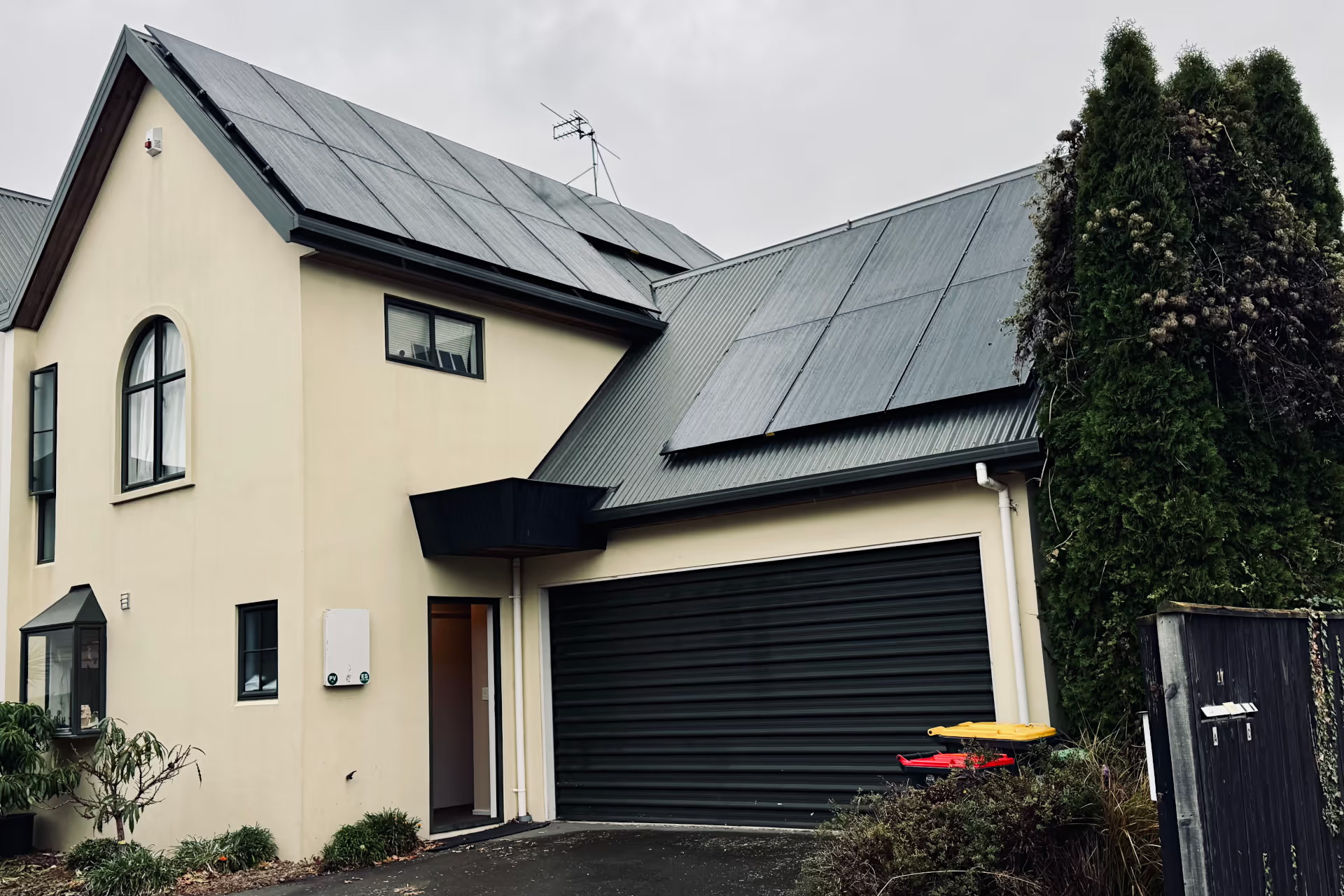
The installers took the initiative to reposition the “legs” of the TV antenna on the roof so that there wouldn’t be a gap between some of the panels. They also painted the section of exposed conduit to a colour that matches the roof. Finally, they also found the best possible location within the house in which the conduit runs from the roof through the house and into the garage, keeping it entirely out of sight except for when it comes into the garage – I could not be any happier with the way they had done this. Kudos to the install team for the fantastic job that they had done.
If there is one thing I can nitpick on, it would be that there’s an asymmetry in the way the cables run on the left and right hand side of the battery unit, along the walls. It does not look pretty to me, and I’ll be looking to get some artwork or similar to cover them up at some stage.
Post-Install
The entire installation of the panels, the battery, and all electrical work only took one day, and that’s mainly due to having a large team of seven people doing the work. From what I understand from friends, who had smaller teams do their installs, it can sometimes take several days to complete a typical install.
Still, the system once installed essentially remained turned off, until the inspector could come round to inspect the system, provide his approval and turn it on. Even then, the paperwork could take a while before they can be collated and sent on to your power company and get your meter reconfigured to start registering your electricity exports. For me, it was exactly four weeks from post-install to meter ready to record electricity exports. Being winter, however, I didn’t “lose” much as just about all the electricity I had generated were captured in the battery or used at the time of generation.
Conclusion
So, what have I learned? What would I do differently if I had to do it again?
I would very likely choose a smaller but well-established company to do the install. We did try to find such a company initially, but the quotes either didn’t come through, or were not very attractive. Since then I’ve heard very good feedback on two smaller businesses now, and would definitely consider them if I had to do another solar panels install. I believe that we’ll likely get better value for money with these businesses, and that it’s likely that they will provide better after-sales service than the company I went with.
I would probably still prefer to have the same products (but with a different hot water timer?) that I had purchased, however. This is mainly due to the idea that should the solar sales company or the installers went into liquidation or were sold to another party, and that they abandon me as a liability customer, that I’m still able to hopefully get support directly from the manufacturer that has got a NZ presence. I hope that it will never get to that stage, but with warranties running decades long, it is well within the realm of possibilities.